

- Connecting audio
- Audio PC
- Raspberry & Co
- All in Ones
- Bluetooth
- Chromecast
- Streaming audio player
- Music server
- USB Audio
- Real-time audio over IP
- FireWire DAC
- Multi-channel DAC
- NAS
- Remote control
- Vinyl rippers
- Acoustic materials
- Active crossover
- Active speakers
- Single driver speakers
- Invisible speakers
- Sound card
- Digital room correction
- Headphone
- Portable media players
Bluetooth LE Audio
Bluetooth LE (Low Energy) was launched in 2011.
In 2022 Bluetooth LE Audio was finalized.
As a consequence Bluetooth Audio was rebranded Bluetooth Classic Audio.
To use Bluetooth LE Audio both sender and receiver must support Bluetooth 5.2 or higher.
Obvious Bluetooth LE Audio uses the Bluetooth LE radio instead of the Basic Rate/Enhanced Data Rate (BR/EDR) radio.
LC3
It uses its own codec called LC3 (Low Complexity Communications Codec).
The combination of LE radio and LC3 codec can be configured to be frugal on power making it ideal for devices like wireless earbuds or hearing aids.
LC3 is scalable. Even at a bit rate as low as 160 kbs, it sounds better than SBC.
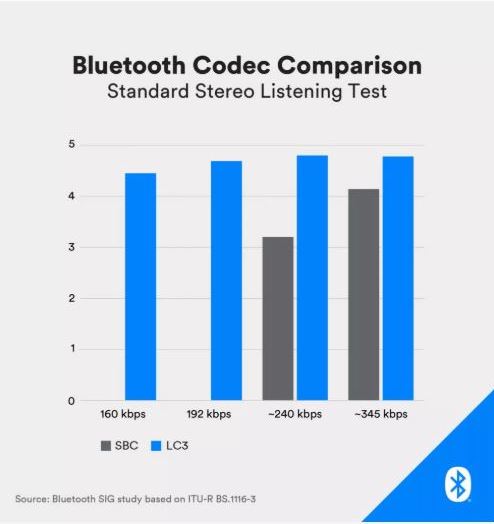
Other improvements are:
Lower latency
Classic Audio is notorious for its latency. A value of 150 ms is not uncommon. LE Audio runs with 20-30 ms latency. Gamers and people sensitive to lip sync will appreciate this.
Multi-Stream Audio
Enables simultaneous transmission of multiple independent audio streams between source and sink devices
Classic Audio allows for only 1 stream. If you have true wireless earbuds, only one is paired with the source. It receives the stereo stream and sends one channel to the other earbud introducing some latency in the process.
In case of multiple streams, both earbuds are paired with the source, one receives the L channel, the other the R and they are perfectly in sync.
Auracast
Allows an audio source to broadcast to an unlimited number of audio receivers.
No pairing needed, users can simply connect.
Multipoint Connectivity
Supports connecting multiple headphones or speakers to a single source simultaneously. This allows you to watch a movie together with your partner each using its own headphone connected to the same source.
What is LE Audio and LC3, the latest in Bluetooth audio? - Robert Triggs 2024